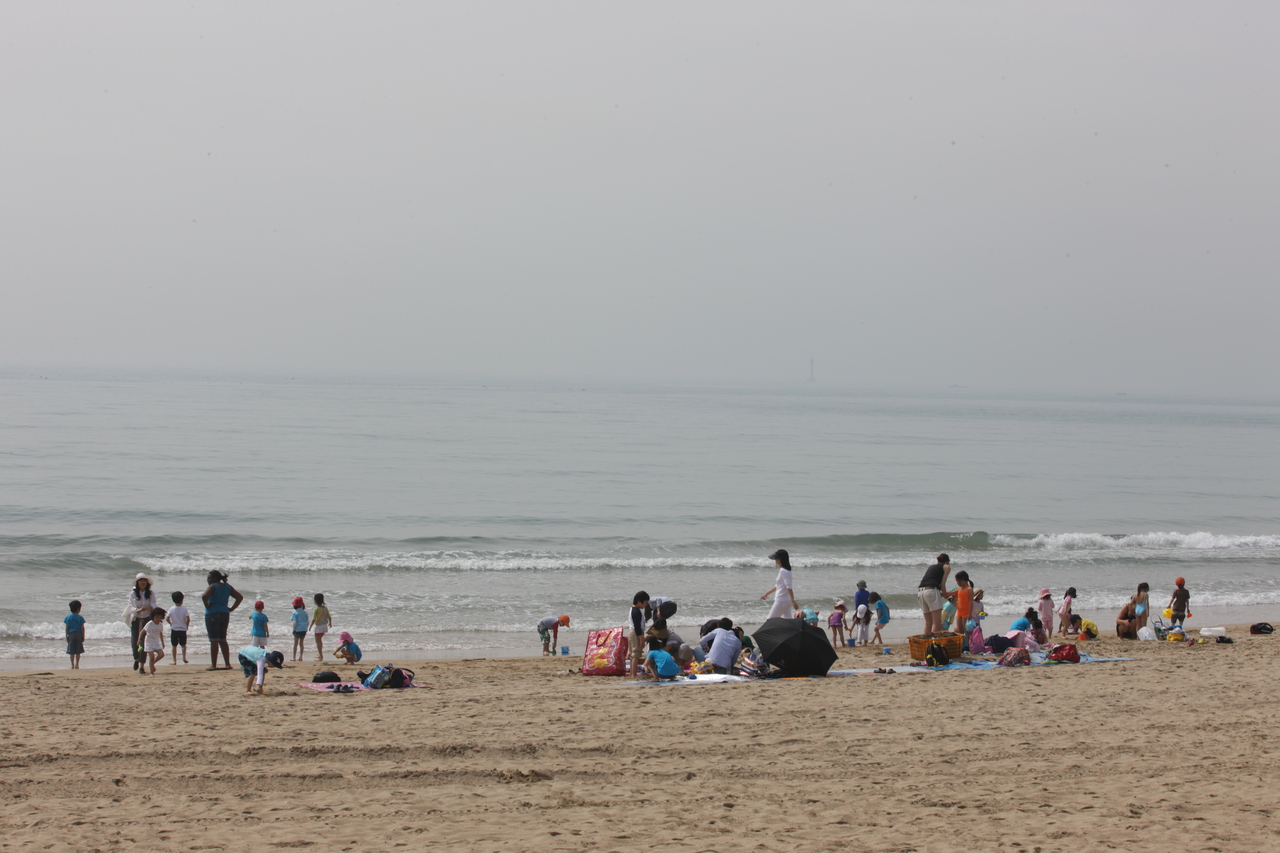
Hills and sea leave so little flat ground that the houses climb the slopes. Two subway stops change the view completely, and Haeundae to Jagalchi runs about forty minutes. Swimming is permitted for barely two months of the summer; if you came to walk, take April, May or October.
01Gamcheon Culture Village
Refugees and the Taegeukdo sect built these houses onto the hillside during the Korean War; the paint came decades later. The lanes are narrow and stepped, running past people's front doors — signs everywhere ask you to keep the camera off the windows.
The temple clings to the rocks, so you hear the surf before you see a hall. From the entrance it is 108 steps down, and the same 108 back up on the way out. On New Year's Day and Buddha's Birthday no car gets onto the access road from before dawn.
One and a half kilometres of sand, twenty minutes to walk from end to end. Outside the summer opening you may not go into the water, though the path around Dongbaekseom at the western end stays open all year.
This beach only really starts when the lights come on along Gwangan Bridge. On Saturday nights more than a thousand drones go up over the water. The road behind the sand is lined with places that pack raw fish to take away. That is what the sand is for.
Pick your fish at a ground-floor stall and it goes up to a restaurant on the first floor, where you pay a separate charge for the table. Prices are settled by haggling, so ask around before committing to one stall.
The loop road is over four kilometres, ninety minutes at a walk, or you ride the Danubi train and get off and back on at each stop. When the swell is up they close the stairs down to the flat rocks below the lighthouse.
A path barely a metre wide cuts through the village along the clifftop, wall on one side and open sea on the other. A tunnel drops you to the quay below, where the boats tie up. People still live here, so keep it quiet after dark.
It sits halfway up Geumjeongsan, so the subway station of that name is only the start; a village bus does the rest. Founded by tradition in 678, its entrance gate stands on four stone pillars rather than wooden ones, which no other temple here does.
Gukje Market grew out of wartime stalls selling surplus US army goods, and whole lanes still sell nothing but crockery, or nothing but tools. Bupyeong, the market next door, puts out its night stalls around half past seven.
The water is so shallow you wade a long way before it reaches your knees, and at low tide the flats open up and the sea retreats out of reach. The fountain at the entrance runs to music on spring, summer and autumn evenings only.
The old Donghae Nambu railway now carries a beach train from Mipo to Songjeong. Between Mipo and Cheongsapo, Sky Capsules for 2 to 4 people run on their own raised rail above the line. Weekend capsule seats go quickly, so reserve beforehand.
Opened in 1913, Korea's first public bathing beach. The cable car crosses open water to Amnam Park, with a separate queue for glass-floored cabins. Off the sand's eastern end, the Cloud Walk curves out over the sea on foot.
A horseshoe of glass flooring juts out from the clifftop over the water. The rocky islets offshore look like five or six depending on the tide, hence the name Oryukdo, five-six islands. Overshoes go on before you step onto the glass.
A path of about 4.7 kilometres along the rocky shore from Dongsaengmal to Oryukdo. Suspension bridges alternate with boardwalk stairs, so allow two to three hours. Several points face Gwangan Bridge and the Haeundae towers straight across the water.
Built in 1934 as Korea's first drawbridge, it was rebuilt in 2013 with the lifting leaf restored. The deck now rises every Saturday at 2pm for 15 minutes, with extra night lifts held some summers. The pavement under the Nampo-dong end gives the closest view.
The only United Nations cemetery in the world, holding the dead of the countries that fought in the Korean War. Every 11 November at 11am veterans' nations observe one minute of silence facing Busan. Photo rules are explained at the gate.
Korean War refugees built their houses over a Japanese cemetery, and the gravestones ended up in retaining walls and steps. Walking the lanes you spot inscribed stones low in the walls. Gamcheon lies just over the ridge, so most visitors combine them.
Opposite Busan station, 168 steep steps climb to the hillside road. In the refugee years people hauled water up them from a well below; today a monorail runs alongside if your legs give out. The top looks down over the North Port.
Even, steady swells make it the Busan beach with the most surf schools. Quieter than Haeundae, with shallow water where beginners can stand up. From the pavilion in Jukdo Park, on the point, you take in the entire curve of sand.
Main stage of the Busan International Film Festival. One cone-shaped block props up a single corner while the vast roof hangs in the air. After dark lights ripple across its underside, and in the October festival open-air screenings sell out fast.
It started with refugees selling secondhand books from street stalls. The gaps between piles stacked to the ceiling are one person wide, so wear your backpack on your front. It is just one road over from Gukje Market.
Ground held first by the Japanese military and then by US forces for close to 100 years, handed back and turned into a park in 2014. A few officers' houses from Camp Hialeah survive as exhibition halls. Seomyeon is a 20-minute walk.
A private wood in Cheolma-myeon, Gijang, tended by one family for nine generations. Thick moso bamboo closes overhead, dim even at noon, and many historical dramas have filmed in it. Entry is paid, and the paths take somewhat more than an hour.