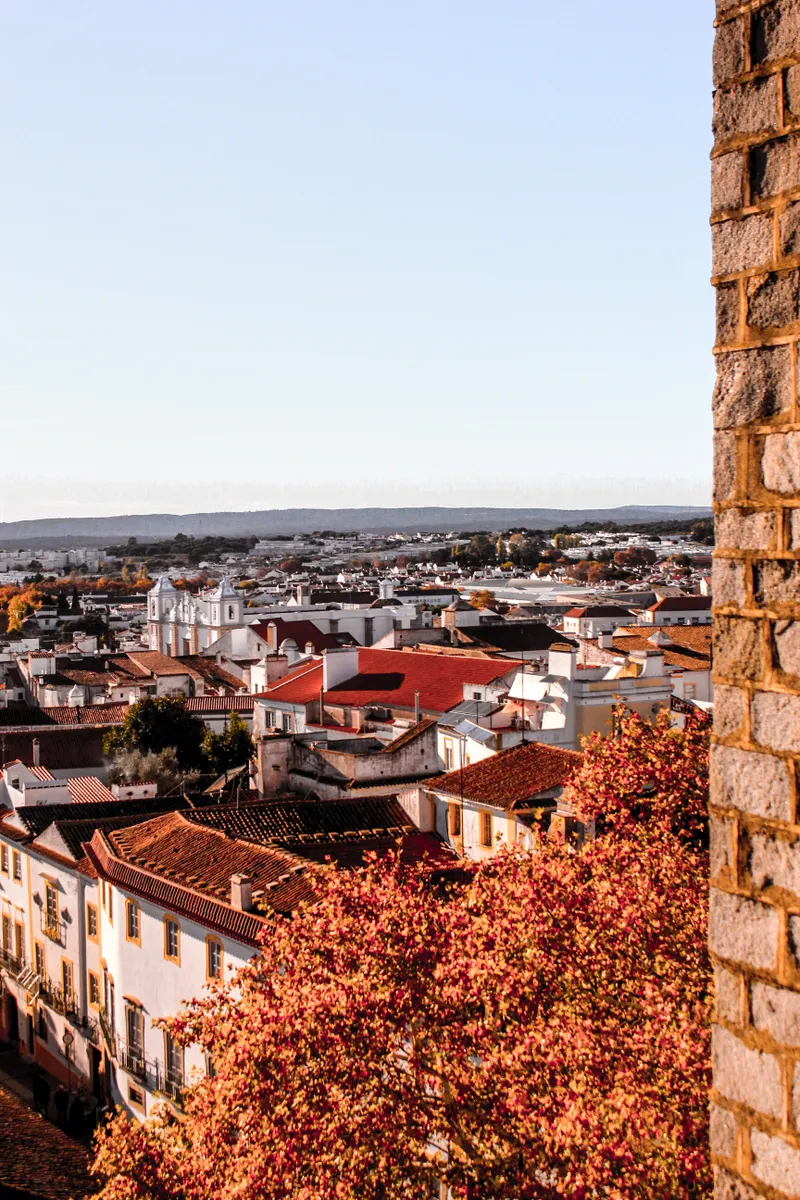
A walled town in the middle of wheat fields and cork oak plains. A Roman temple, a medieval cathedral and a chapel lined with human bones all sit within ten minutes on foot. Summer afternoons push towards forty degrees, so spring and October are the times to come.
01Roman Temple
Fourteen columns from the first century still hold the centre of the square. Walls went round them in the middle ages to make a slaughterhouse, and that is what kept them from being pulled down.
The bones of some five thousand monks line the columns and walls of one small chapel. A line above the door tells you to think on death, and the air inside stays cold.
A sixteenth century aqueduct runs into the walled town with houses wedged between its arches. Cars pass beneath while the channel above still carries water.
The main square inside the walls, arcaded on three sides. On summer evenings people settle around the fountain, and by day everyone keeps to the shade of the arcade.
Twenty minutes out in a field, ninety five standing stones form an oval older than Stonehenge. There is no gate and no ticket, and cork oaks close the ring around it.
You walk a grove where the bark is stripped once every nine years and read the number painted on each trunk. The stripped band stays red, so the age of the cut shows at a glance.
A garden against the inside of the wall, sharing its ground with a fifteenth century palace fragment and a flock of peacocks. By afternoon the older residents have taken every bench.
A white village on a hilltop forty minutes away, looking down on a wide reservoir. Street lighting is kept low, and the area is designated for night sky viewing.
A 15th-century convent church right beside the Roman temple, still owned by the Dukes of Cadaval. Blue tile scenes painted in 1711 climb every wall up to the vaults. Small trapdoors in the floor lift to show an ossuary and an Islamic-era cistern below.
A white town north of Evora, crowned by a ring of round castle walls. It is famed for wool-stitched rugs, and workshops around the main square let you watch them being made. Inside the walls only a church remains, so walk the circuit of the ramparts.
An Alentejo town so rich in marble that doorsteps and pavements are cut from it. Saturday mornings bring a market to the lower square, with the painted clay figurines UNESCO listed in 2017. The hilltop castle's Tower of the Three Crowns overlooks the plain.
The palace of the Dukes of Braganza, its whole facade in local marble. King Carlos left here for Lisbon in 1908 and was assassinated the day he arrived; his private rooms survive untouched. Entry is only with a guide.