01Mill Colonnade
A neo renaissance walkway on 124 columns holds five of the hot springs. Each one comes out at a different temperature, and the figure is posted beside it.
OPEN IN MAPS© Marina Zvada · Pexels License · Pexels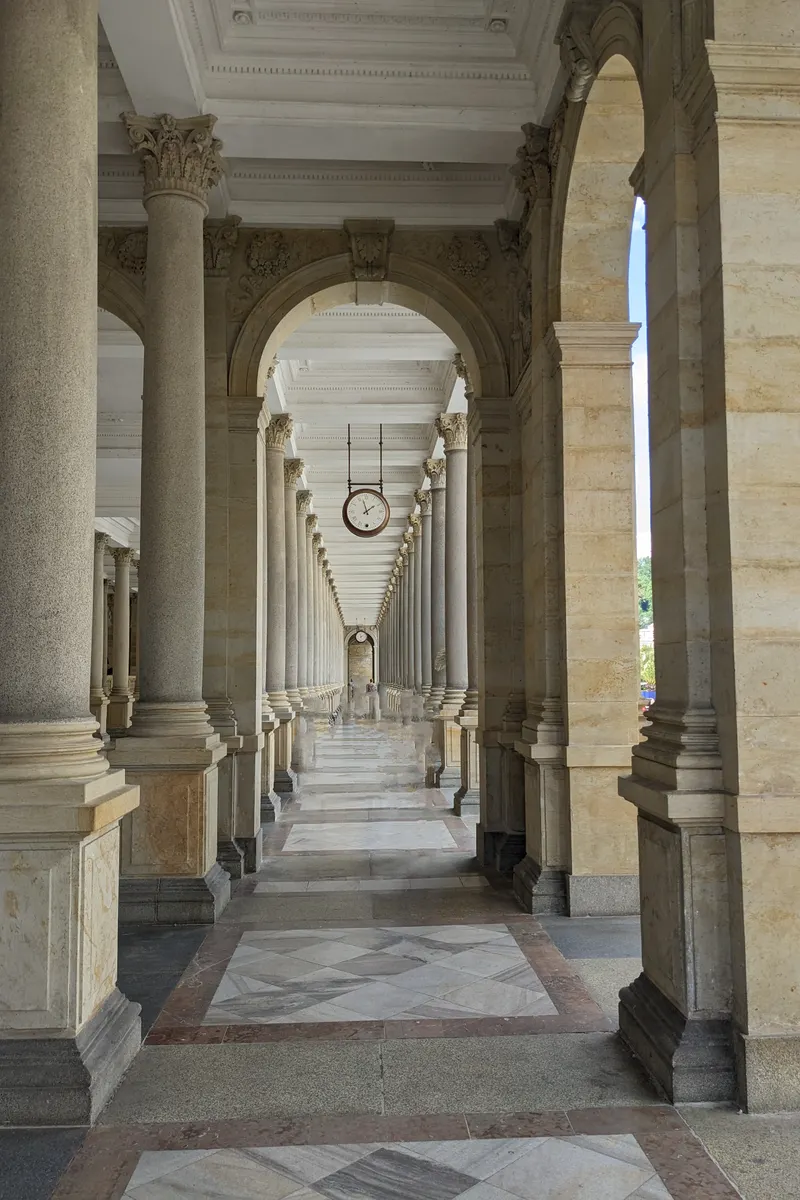
Thirteen hot springs rise along a narrow valley, each covered by a colonnade built for drinking rather than bathing. The water carries heavy minerals, so it is taken by mouth and baths happen indoors at the spas. Valley colour joins the walk during May, June, September, October.
A neo renaissance walkway on 124 columns holds five of the hot springs. Each one comes out at a different temperature, and the figure is posted beside it.
OPEN IN MAPS© Marina Zvada · Pexels License · PexelsThe strongest hot spring in the valley throws water at 73 degrees up to 12m. It is too hot to drink at the jet, so cooled taps beside it are used instead.
OPEN IN MAPS© Anastasiia Klochko · Pexels License · PexelsA flat cup whose handle is hollow works as the straw. The shape settled this way to slow people down while the water is hot.
OPEN IN MAPS© granüllükahve ``` · Pexels License · PexelsA funicular climbs the slope, and 150 more steps up the tower open the whole valley. Forest paths fan out below it if you would rather walk down.
OPEN IN MAPS© Raymond Petrik · Pexels License · PexelsA hotel running since 1701, familiar from films, and photographed constantly from the street. The ground floor cafe is open whether or not you are staying.
OPEN IN MAPS© Raymond Petrik · Pexels License · PexelsGlass has been blown by hand here since 1857, and the floor is watched from behind glass. Working with molten gobs throws heat as far as the visitor walkway.
OPEN IN MAPS© cottonbro studio · Pexels License · PexelsFor nine days at the start of July the whole town turns into a screening venue. Room prices climb steeply then, and the valley does not go quiet at night.
OPEN IN MAPS© Roxana Herlea · Pexels License · PexelsA bronze chamois stands on a rock west of the valley at a viewing point. Thirty minutes of forest path gets you there, or you walk from the funicular's middle station.
OPEN IN MAPS© Magda Ehlers · Pexels License · PexelsA white timber walkway in Swiss style, put up in the first place as a temporary structure. The carving is dense enough that up close the tool marks in the wood show.
OPEN IN MAPS© Magda Ehlers · Pexels License · PexelsThe old factory of the herb liqueur is open as a museum. It finishes with a tasting by type, and a panel states that only two people know the recipe.
OPEN IN MAPS© Olena Bohovyk · Pexels License · PexelsA Baroque church just above the Vridlo geyser colonnade, built in the 1730s by Kilian Ignaz Dientzenhofer. Set into the slope, it has a tall flight of front steps. The crypt underneath is visited only on scheduled guided rounds.
OPEN IN MAPSAn Orthodox church built in the 1890s for the Russian guests who came to take the waters. Five gilded onion domes rise above the wooded hillside. Inside there are no pews, and an icon screen hides the altar.
OPEN IN MAPSA white cast-iron colonnade by the Viennese architects Fellner and Helmer, at the end of Dvorak Park. Next to it, a snake-head spout trickles lukewarm mineral water. The big colonnades draw more people, so this one suits a quiet rest with your cup.
OPEN IN MAPSA castle and village on a rock wrapped by the Ohre in an elbow-shaped loop, a short bus ride from Karlovy Vary. The name, meaning elbow, comes from that bend. Goethe stayed several times, and the castle holds an exhibition of local porcelain.
OPEN IN MAPSAnother spa town ringed by forest, about 50km south of Karlovy Vary. Before the cast-iron colonnade, a singing fountain dances to music several times a day from May to October. Parks take up about half the town, so it is good for walking.
OPEN IN MAPSA castle perched in a wooded valley, holding the Romanesque gold reliquary of St Maurus. Found in 1985 buried under the chapel floor, it ranks second only to the crown jewels among Czech treasures. The reliquary and castle tour are ticketed separately.
OPEN IN MAPS