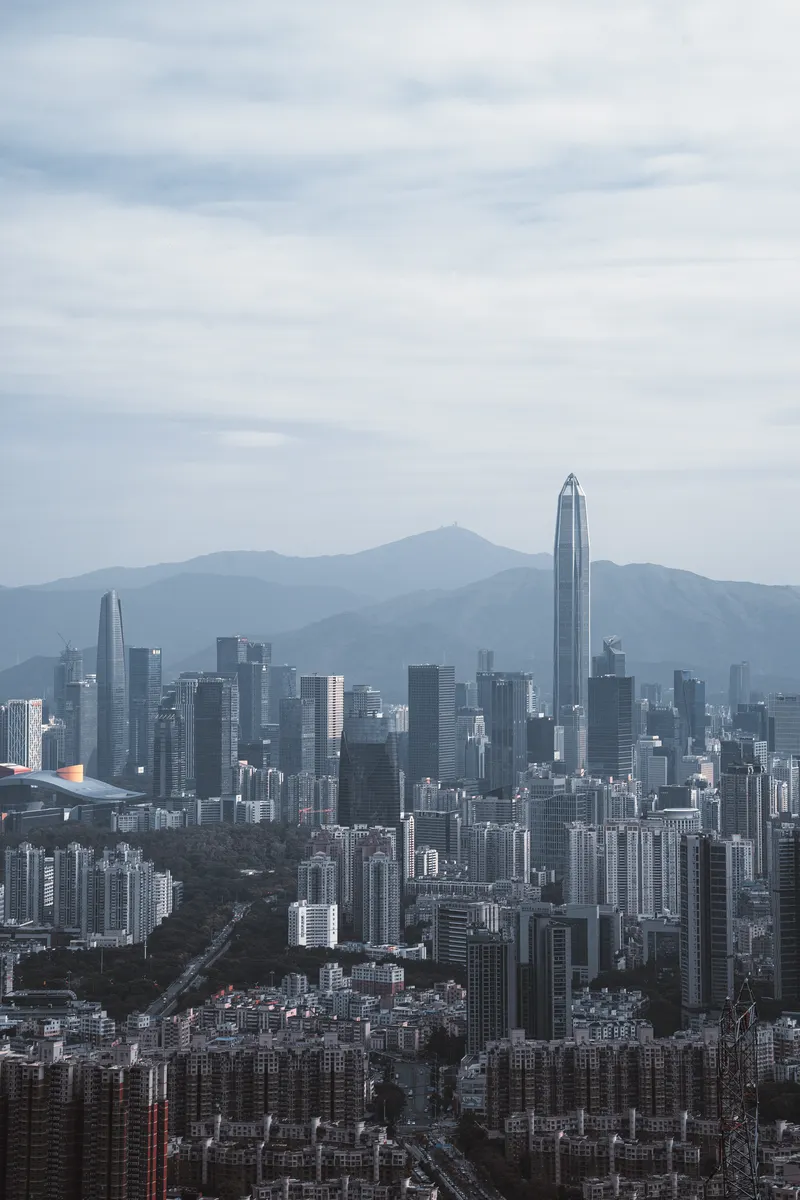
Before it became a special economic zone in 1980 this was a small market town and some fishing villages facing Hong Kong; over ten million now live here. The border runs along its edge, crossed on foot at Luohu or Futian. Summer typhoons are frequent, so October to December and March are easier.
01Lianhuashan Park
On the summit plaza a statue of Deng Xiaoping, put up in 2000, strides forward. Stand in front of him and the Civic Centre and the Futian towers line up straight below. At weekends many people fly kites on the lawns lower down.
A seafront path runs for more than ten kilometres, and the shore across the water is Hong Kong's Yuen Long side. Mangroves root in the mudflats, which draws migrating birds in winter. With almost no shade, walk it toward sunset, not by day.
The Ming raised this coastal fort in 1394 to keep off pirates, and it is still lived in, with shops open down every lane inside the walls. It is over an hour east of the centre, so it gets paired with the Xichong coast for a full day.
A scramble over rocky shore between two beaches at the far south end of the Dapeng peninsula, four or five hours long. High tide covers the rock sections and they cannot be passed, so read the tide table before setting off. No shops on the way; carry water.
Every floor of every building is cut into hundreds of stalls the size of a desk, each piled with one kind of part. Small pieces like resistors and connectors go by the bag rather than singly, and the phone repair counters fix yours while you wait.
Factory buildings from the 1980s turned into galleries, bookshops and cafes. Vine-covered lanes run between the brick sheds, and on weekend afternoons a small market sets up in the yard. A good share of the galleries close on Mondays.
Thousands of painters work in this village turning out copies of famous canvases, and half-finished ones stand like walls along both sides of the lanes. Hand over a photo and you have it in oils within days; many studios will ship abroad too.
The nearest swimming beach to the centre with a metro stop, so on summer weekends the sand vanishes under people. A row of winged human figures stands along the promenade. Weekday mornings are quiet.
The old market that first carried the name Shenzhen stood here, and it is now lanes of cheap clothes and shoes. A small shrine and bell recall the old market deep inside, and stalls stay busy until late at night.
The seat of Xin'an county, which once governed both Shenzhen and Hong Kong, with a Ming south gate still standing. Old houses in its lanes have become bookshops and teahouses, and one gate off the main road the traffic noise suddenly drops away.
Shrunken world landmarks, from the Eiffel Tower to the pyramids and the Taj Mahal, in a theme park opened in 1994. The Eiffel copy is 108m tall and a lift rides up to its top deck. Every model is lit after dark, which brings in an evening crowd.
Miniatures of Chinese landmarks such as the Great Wall and the Potala Palace, beside rebuilt minority villages; it opened in 1989. A big costumed show runs in the evening, and it shares the OCT district with Window of the World, so one day covers both.
At 944m the highest peak in Shenzhen. From the summit the city spreads to one side, and the hills of Hong Kong's New Territories and the sea to the other. The stepped path is long, so allow half a day up and down, and go on a clear winter day to see far.
The Minghua, once a French passenger liner, was hauled onto the Shekou shore in 1983, and bars and restaurants grew up around it. Plenty of foreigners live nearby, so English menus are common, and the design museum opened in 2017 stands right in front.
At 599m the tallest building in Shenzhen, with a deck on the 116th floor over the Futian centre and Shenzhen Bay, and in good weather out toward Hong Kong. In fog the windows show only white, so check the sky that morning before buying a ticket.
A broad garden below the west flank of Wutong Mountain; climb from the lake and Hongfa, a large monastery, sits on the slope. Petrified trunks in the fossil forest and the cactus houses are the draws, and many take the sightseeing carts up from the gate.