The harbour cuts so far in that ferry wharves do the work subway stations do elsewhere. The Opera House and the Harbour Bridge stand in one view from Circular Quay, and the eastern beaches are half an hour out by bus. The comfortable months for walking are March and April, then October and November.
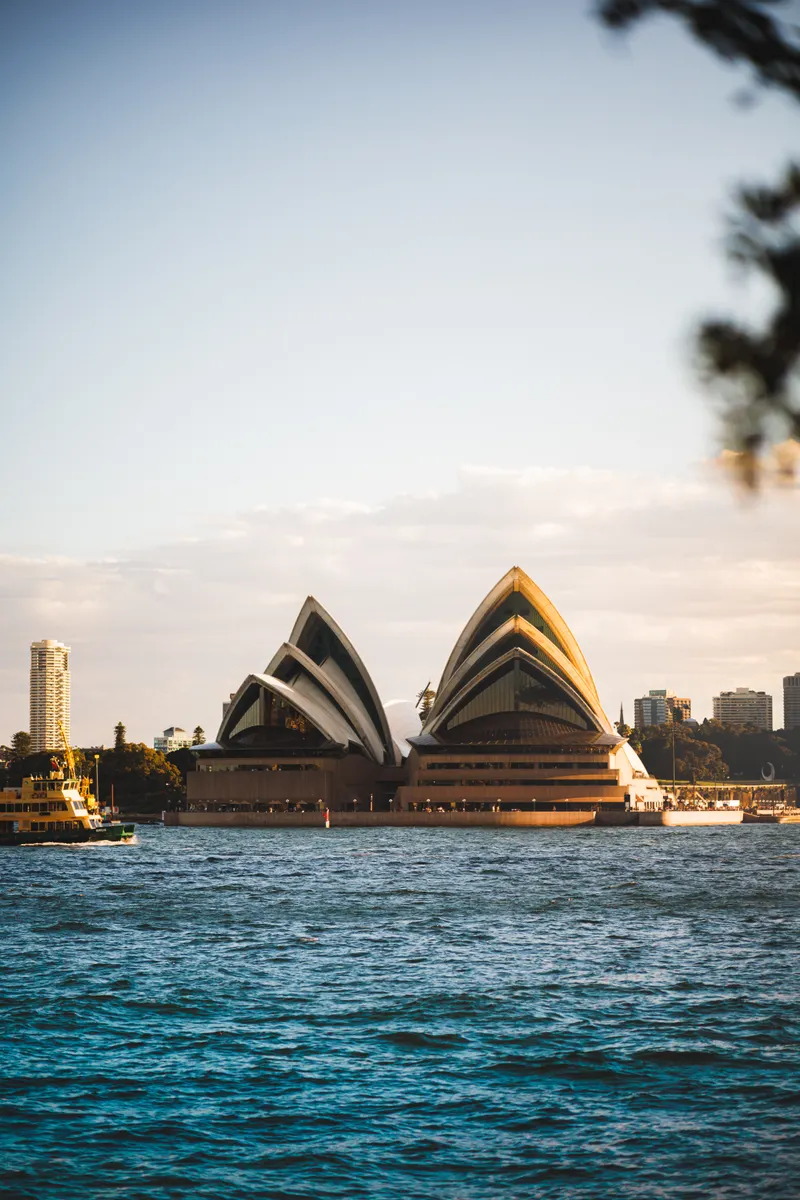
01Sydney Opera House
The roof tiles are not one white but two, a glossy white and a matt cream. Stand close and the surface looks blotchy; only distance pulls it into a sheet. To see the halls you sign up separately for the backstage tour that goes round in the morning.
Besides the BridgeClimb over the arch there is a lookout reached by stairs inside the stone pylon at the southeast end. It costs a fraction as much and stands nearly as high, so if all you want is the photograph this is the better door.
The path follows the cliff from Bondi to Coogee, dipping into one bay after another. At Waverley Cemetery the headstones lean over the water and everyone slows. In spring a sculpture show is laid along it, and for those weeks you shuffle.
The garden runs along the harbour behind the Opera House and has no fence, so you step in from any side. On the sandstone point at its east end a bench was cut from the rock for the governor's wife, and that angle overlaps house and bridge.
Plague reached the port in 1900 and the lanes on the harbour side came down and were rebuilt. Cadman's Cottage, put up in 1816 as quarters for a boat crew, came through it. On Saturday and Sunday stalls take over the lanes and you move at half speed.
Leave the harbour cruise ticket alone and take the scheduled ferry to Manly. It crosses the same water for what a city bus costs and takes thirty minutes. The open seats at the bow meet the swell face on where the boat slips between the Heads.
Three sandstone pillars, set to be looked at across the valley from Echo Point rather than from below. The blue haze is light scattering off oil the eucalypts breathe out. Take the Giant Stairway down and the climb back costs twice the time.
Built in 1819 for convicts, now a museum about nothing else. Hammocks hang in rows upstairs, so the width one man got is measurable by eye. Under the floorboards lay thousands of objects rats dragged there: buttons, cards, letter scraps no ledger held.
A convict prison that turned into a shipyard, and the only way onto it now is the ferry. The docks and tunnels have not been altered, and on the grass above them a campground hires out tents for the night.
A sandstone cliff you reach by ferry from the centre, with one rail between the path and the drop. The Dunbar struck the rocks below it in 1857 and a single man out of everyone aboard came out alive.
A zoo across the harbour from Circular Quay by ferry, its enclosures stepped down a steep hillside. Giraffes pose against the Opera House and city towers, so one frame catches both. The wharf is at the bottom: start at the top gate and work downhill.
A container wharf remade as a headland park in 2015. The sandstone blocks edging the water were quarried from the site itself during construction. It faces the bridge's far western footing head-on, and at dusk people settle on its grass.
The state gallery in the Domain beside the Royal Botanic Garden; the permanent collection needs no ticket. A second building opened in late 2022, linked across the parkland. Its lowest level is a buried Second World War navy fuel tank, now a gallery.
A Romanesque market hall finished in 1898, filling an entire city block. It nearly fell to the wreckers decades later, was restored during the 1980s and now houses shops. Two huge clocks hang under the glass roof, and everyone ends up gazing upward.
A seawater pool carved into the rocks where Bondi Beach ends to the south. When the swell is big, the ocean breaks over the wall into the lanes. Anyone may swim after paying entry; the name belongs to the club whose members swim here weekly all winter.
A walk of about 10km along the harbour's northern shore from the Spit Bridge to Manly. Bush tracks alternate with small sandy coves, and on one headland Aboriginal rock engravings survive. It finishes close to Manly wharf; return by ferry.
Declared in 1879, the world's second-oldest national park begins one hour south of the city. Many cross from Cronulla to Bundeena by small ferry and start the clifftop coast walk there. Waves sweep the rock pools; go only at low tide in calm seas.
An amusement park opened in 1935 right under the bridge's north shore approach. The entrance is a giant grinning face, and you walk in through its mouth. Getting into the grounds costs nothing; tickets are bought only for the rides.
A sandstone lighthouse from 1881 crowning the headland at Palm Beach, the city's northern tip. A steep track climbs to it between ocean and Pittwater. Palm Beach is where the long-running series Home and Away is shot, so some days a crew is filming.
Built beside Darling Harbour for the 1988 bicentenary, designed by landscape architects from the sister city Guangzhou. Ponds, pavilions and a waterfall fill the walled space, so the towers just outside barely show. The teahouse looks over the pond.
After the painter Brett Whiteley died, his wife Wendy turned derelict railway land below their house into a garden with her own hands. Steps and benches hide down the Lavender Bay slope, the harbour glinting between them. No fence or ticket office: wander in.
A Katoomba clifftop attraction in the Blue Mountains where an old mine track carries the world's steepest passenger railway. Ride down to the rainforest floor, walk the boardwalk, return by cable car. Central to Katoomba takes two hours; catch a morning train.