The city takes its name from the naval command that governed three provinces from here. Islands start just offshore, so half of any itinerary happens on a boat, and in winter the water is thick with oyster-farm buoys. March and April, for the flounder and mugwort soup, or else autumn.
01Dongpirang Mural Village
The hill was scheduled for demolition and the murals are what saved it. The paintings are recommissioned every couple of years. Whatever you saw last time is probably gone. From the top the whole of Gangguan harbour lies open below.
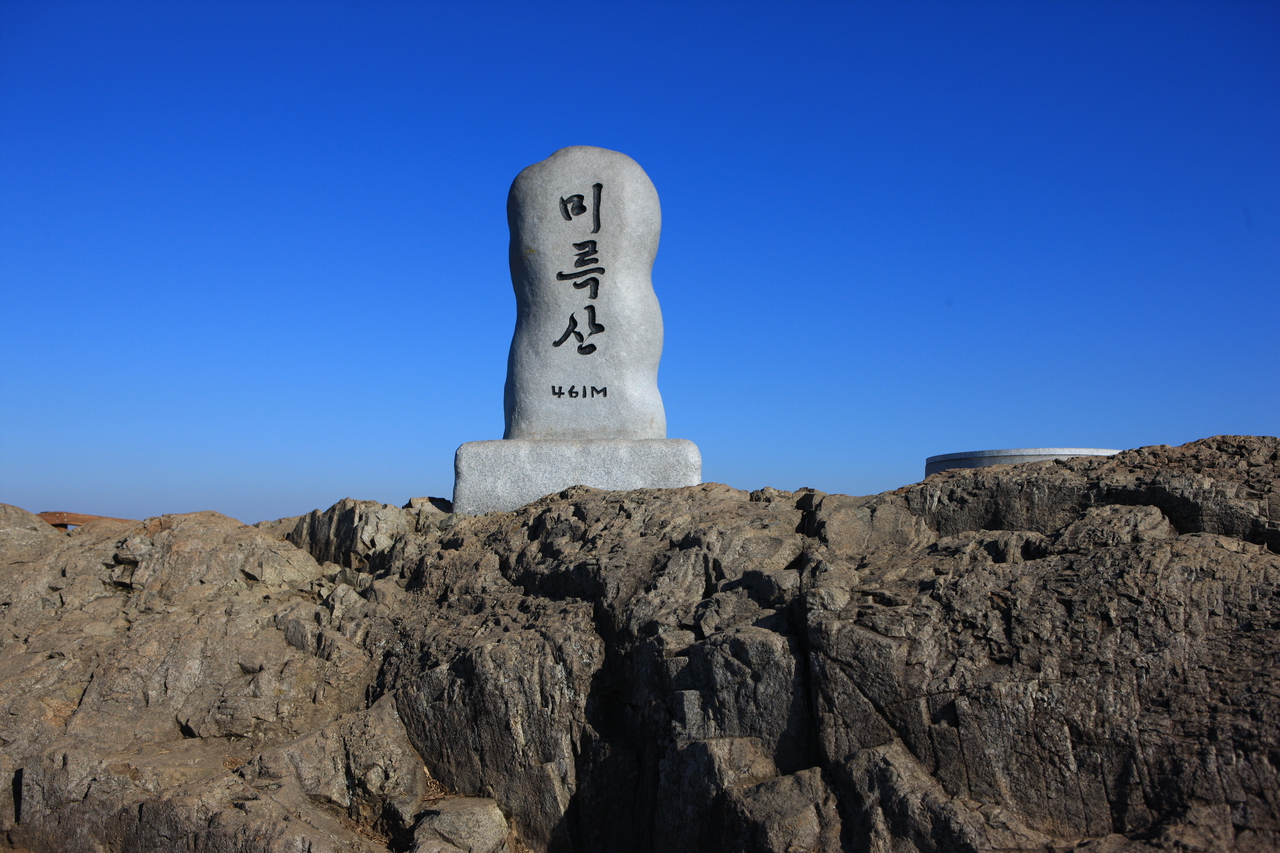
It climbs 1.9 kilometres toward the top of Mireuksan, one of the longer lines in the country. From the upper station it is another ten minutes up wooden steps to the viewpoint. On a clear day the Hallyeo islands stack up in layers.
Built in 1605 as the guest hall of the naval command, and designated a national treasure. There are no interior walls, only columns, so from the floor you can see straight through from one end of the building to the other.
The water reaches right into the middle of town here, with fishing boats moored a few metres from shop fronts, a reconstructed turtle ship at the quay and stalls coming out on the square beside it every evening.
A gravel bar surfaces at low tide and lets you walk across to the lighthouse island; as the water comes in, the path disappears. If the ferry timetable and the tide do not line up, you look at it from the far side and go home.
Twenty-five minutes by boat from Tongyeong, and the spot where Yi Sun-sin first set up his command. The watchtower from his best-known poem has been rebuilt. Sit in it and you are looking at the same water.
A rise partway along the south coast road of Mireukdo, and the reason to come is watching the sun drop between the islands. The car park is small and full half an hour before sunset.
It opens at four in the morning, and a lot of people come here for breakfast rather than to shop. By midday much of it is already packing up, so arriving late means arriving to nothing.
Park Kyung-ni, who wrote the novel Land, was born in Tongyeong, and her grave is on the slope behind the memorial hall. Most visitors say it is the sea from that slope, not the exhibits, that stays with them.
An hour by ferry from Tongyeong, and you can take a car across. The coast road on the island is narrow and tightly wound, which makes the driving harder than it looks. A monorail runs to the summit for anyone who would rather not walk.
Dug under the strait between the town and Mireukdo in 1932, a 483m tunnel billed as the first undersea tunnel in the East. It is closed to vehicles and crossed only on foot. The lettering over the entrance and the concrete walls are original.
Two islands joined by a thin sandbar, a sand beach facing one way and a pebble beach the other, back to back. The crossing from Tongyeong harbour takes around 40 minutes. Hike the hill path to the viewpoint and the pinched waist of land shows whole.
A rock-ridge hike on an island some 40 minutes by boat from Gaochi port. Knife-edge crests are crossed on ropes and steel stairs, and suspension bridges span the gaps near Oknyeobong. Anyone wary of heights should take the bypass; wet rock is slick after rain.
The western hill opposite Dongpirang, whose lanes were the setting of Park Kyung-ni's novel The Daughters of Pharmacist Kim. Climb the 99 steps to the Seoporu pavilion for Gangguan and Dongpirang across the water. Far fewer people come; walk it slowly.
Built in 2013 on a seaside hill in honour of the composer Isang Yun, who grew up in Tongyeong. The Tongyeong International Music Festival is held here each spring. With no concert on, the sea-facing terrace and walking paths stay open.
Named because from the sea it resembles a lotus bud, an island roughly an hour's sailing from Tongyeong. At its eastern tip a line of rock pinnacles called the Dragon's Head runs into the sea, linked by a suspension bridge. Yeonhwasa temple draws pilgrims.